


 American Latina
 ANZ
 Austria
 Brazil
 Czech
 Finnish
 France
 Germany
 Italy
 North
America
 Norway
 Polish
 Portugal
 Spain
 Sweden
 United Kingdom
Consumers are becoming more conscious of packaging waste, brands are racing to reduce their environmental footprint, and governments are introducing stricter regulations to tackle packaging waste. Against this backdrop, one everyday item is undergoing a remarkable transformation: the drinks bottle. While plastic has long dominated supermarket shelves, a new generation of innovative materials is emerging, with fibre-based bottles leading the conversation.
The problem with plastic
Plastic drink bottles remain one of the most common forms of single-use packaging found around the world. It’s estimated that more than one million plastic bottles are purchased every minute globally, many of them designed to be used just once before being recycled or discarded.[1] While recycling plays an important role in keeping materials in circulation, manufacturers are increasingly exploring ways to reduce reliance on virgin plastic altogether by developing packaging made from renewable materials such as paper fibre.
Johnnie Walker Leads the Way
One of the most ambitious projects comes from Diageo, the company behind Johnnie Walker.
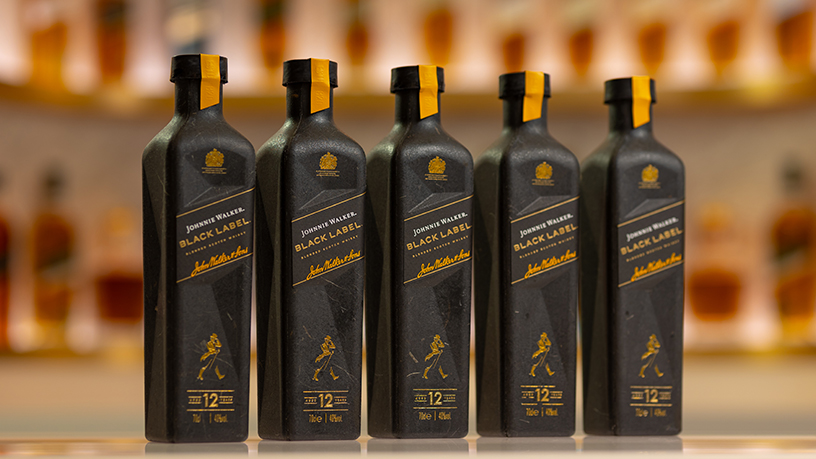
Working alongside PA Consulting and Swedish technology company PulPac, Diageo has developed a 70cl Johnnie Walker Black Label bottle made from 90% paper fibre. The bottle is around 60% lighter than its glass equivalent and is estimated to produce almost half the carbon emissions during its lifecycle. [2]
The project earned recognition at the London Packaging Week Innovation Awards, demonstrating that fibre-based bottles are moving beyond prototypes and into real consumer trials.
It’s Not Just Whisky
Johnnie Walker isn’t alone in exploring fibre bottles. Carlsberg has been developing its Green Fibre Bottle for several years, trialling paper-based beer bottles as part of its wider sustainability ambitions.[3] Meanwhile, Coca-Cola has also tested fibre-based bottles through pilot programmes, exploring how renewable materials could complement its broader packaging strategy. Although each design differs, they all share the same objective: reducing dependence on virgin plastic while maintaining product performance.[4]
Challenges Still Remain
Despite the progress, fibre bottles are not yet ready to replace every glass or plastic bottle.
Many beverages require advanced barrier layers to prevent leaks, preserve freshness and maintain carbonation. Developing coatings that perform well while remaining recyclable continues to be one of the industry’s biggest technical hurdles. There are also infrastructure considerations. Recycling systems vary between countries, meaning new packaging formats must be designed with existing collection and sorting systems in mind. Cost is another factor. As with many emerging technologies, production becomes more affordable as manufacturing scales up.
The drinks bottle has remained largely unchanged for decades. Thanks to collaboration, innovation and advances in paper-based packaging, that may finally be starting to change.
Sources
2. UK Packaging Awards, PA Consulting, PulPac, and Diageo work towards fibre bottle, 2026
4. Coca-Cola Belarus, Here’s our first paper bottle prototype, 2020