



 America Latina
 ANZ
ANZ
 Austria
 Germany
 North America
 Italy
Italy
 Brazil
 United Kingdom
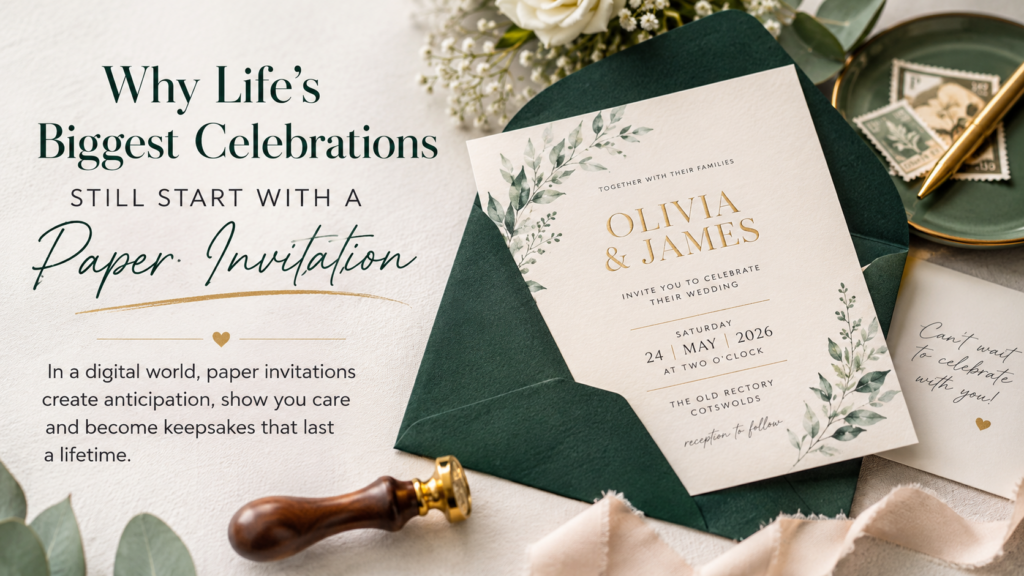
From online calendars and instant messaging to digital RSVPs and virtual events, much of modern life has moved online. But despite this shift towards digital communication, one tradition continues to hold its place: the paper invitation. Whether announcing a wedding, milestone birthday, christening or anniversary celebration, paper invitations remain a popular choice for life’s most significant moments.
At first glance, this seems surprising. Digital invitations are convenient and often free to send. They can be designed, distributed and, importantly, responded to within minutes. Yet when it comes to marking major life events, many people continue to choose printed invitations over their easier digital counterparts. The reasons for this go beyond tradition. Physical invitations offer something that digital communication struggles to replicate: emotional significance.
Nowhere is this more evident than in the world of weddings. While couples increasingly use wedding websites and rely on online RSVPs, paper wedding invitations remain a central part of the celebration. According to guidance from major UK wedding planning platforms, printed invitations continue to be considered a key milestone in the wedding planning process, often serving as the official announcement of the event itself. Digital tools may help manage logistics, but the invitation remains a physical representation of the occasion.
Part of the enduring appeal of wedding invitations lies in their ability to signal importance. An email can easily be deleted or buried in an inbox. A printed invitation, by contrast, demands attention. Arriving through the post, it creates a moment of anticipation and ceremony before the event has even begun. Recipients are invited to physically open the envelope and engage with the details in a more deliberate way.
This experience is closely tied to the unique qualities of paper. The weight of a card, the texture of the stock and the design choices all contribute to how the invitation is perceived. Whether minimalist or elaborate, the physical object communicates care and intention. In many cases, it provides guests with their first glimpse of the event’s style and atmosphere. Long before a venue is seen or vows are exchanged, the invitation begins to tell the story of the special day.
The continued popularity of wedding stationery also reflects a broader cultural appreciation for tangible experiences. Physical objects often carry greater emotional value precisely because they are less common in today’s digital world. Just as readers continue to buy books alongside e-books, and music fans collect vinyl records despite streaming services, many people still appreciate receiving something they can hold in their hands. Paper provides a sensory experience that screens cannot replicate.
Importantly, invitations are not simply functional documents; they often become keepsakes. While digital invitations typically disappear once an event has passed, printed versions often remain. They are tucked into memory boxes, saved in scrapbooks or stored alongside photographs and mementoes.
This role as a keepsake helps to explain why physical invitations continue to endure. Significant life events are often accompanied by a desire to create lasting memories. Paper naturally supports this. Unlike digital files, which can be lost among thousands of emails and photographs, a printed invitation occupies a physical space. It can be displayed and rediscovered over time.
The rise of personalised design has further strengthened the appeal of paper invitations. Today’s couples and event organisers have access to a wide range of creative options, from bespoke illustrations and letterpress printing to textured papers and foil finishes. These elements transform invitations from simple information carriers into meaningful design objects. The invitation becomes part of the event experience rather than merely an administrative necessity.
Another factor contributing to the longevity of printed invitations is their ability to foster connection. Receiving a physical invitation feels far more personal than receiving a digital notification. The act of sending something through the post carries a sense of effort and consideration. In an era of instant communication, this intentionality feels especially meaningful.
For many families, invitations also become part of a shared history. Looking through old wedding albums or keepsake boxes can reveal invitations from previous generations, providing small but powerful glimpses into the past. As such, invitations can serve not only as reminders of individual events but as pieces of family heritage.
The resilience of printed invitations also highlights an important distinction between convenience and significance. Digital communication excels at speed and efficiency. It allows information to be shared instantly and widely. However, not every interaction is solely about convenience. Some occasions deserve a greater sense of occasion. A wedding, milestone birthday or anniversary is not merely an entry in a calendar; it represents a meaningful life event, and paper reflects that significance.
This does not mean that digital and physical communication are in competition. In reality, many modern events use both. Save-the-date messages may be sent electronically, while formal invitations arrive in printed form. Wedding websites provide practical information, while paper invitations establish the emotional tone of the celebration. Rather than replacing one another, digital and physical formats often work together, each fulfilling a different purpose.
Ultimately, the continued appeal of paper wedding invitations, printed invitations and other forms of special occasion invitations reflects a simple truth: people still value meaningful physical objects. While technology has transformed the way we communicate, it has not diminished the desire to mark life’s biggest moments in a tangible way. For celebrations that matter most, paper continues to provide a lasting and memorable place to begin.