


 American Latina
 ANZ
ANZ
 Austria
 Brazil
 Czech
Czech
 Finnish
 France
 Germany
 Italy
Italy
 North
America
North
America
 Norway
 Polish
 Portugal
 Spain
Spain
 Sweden
 United Kingdom
Inclusive packaging has gradually moved beyond niche innovation into a design priority. In the past year, leading brands have shown that accessibility is a fundamental part of how products are experienced. From household goods, technology and beauty, packaging is being rethought to support people with a wide range of physical, sensory and cognitive needs.
Three standout examples: TILT Beauty, Ariel and Microsoft, illustrate how inclusive packaging is evolving.
TILT Beauty

Beauty has been at the forefront of accessible design development in recent years. While large corporations are adapting existing systems, TILT Beauty was built entirely around accessibility from the outset.
Designed for people with arthritis, tremors, and reduced grip strength, its packaging challenges the previous small, delicate components that required precision. Amongst their range, you’ll find features such as weighted bases, large ergonomic handles and magnetic closures.
TILT Beauty designs alongside disabled individuals, and all features are not just theoretical but are thoroughly user-tested. This practice of design may seem simple, but it ensures TILT Beauty is designing for real physical limitations. It’s something that should be adopted within all organisations.
Ariels SECURECLIC® Box

Laundry detergent might seem like a mundane category, but Ariel has turned it into a case study in inclusive design with its new Secureclic box, which was recently launched in Europe.
The innovation lies in balancing child safety with adult usability, something that has historically been difficult. The ergonomic opening system is designed to reduce strain and complexity, making it easier for people with limited dexterity to access the product. Along with this, the new packaging features: large, high-contrast instructions and a tactile symbol that allows blind and low-vision users to identify the product by touch.
Additionally, the use of cardboard packaging also contributes to the product’s sustainability credentials. Paper and cardboard packaging have recycling rates of around 79% in Europe1, making them among the most widely recycled packaging materials. This means the Secureclic box not only improves accessibility through inclusive design but also supports circular economy goals by using a material that is more likely to be successfully recovered and reused.
What makes this significant is the multi-layered approach: physical, visual, and digital accessibility working together.
Microsoft Product Experience
For Microsoft, accessible packaging is not separate from the product; it’s part of the overall user journey.
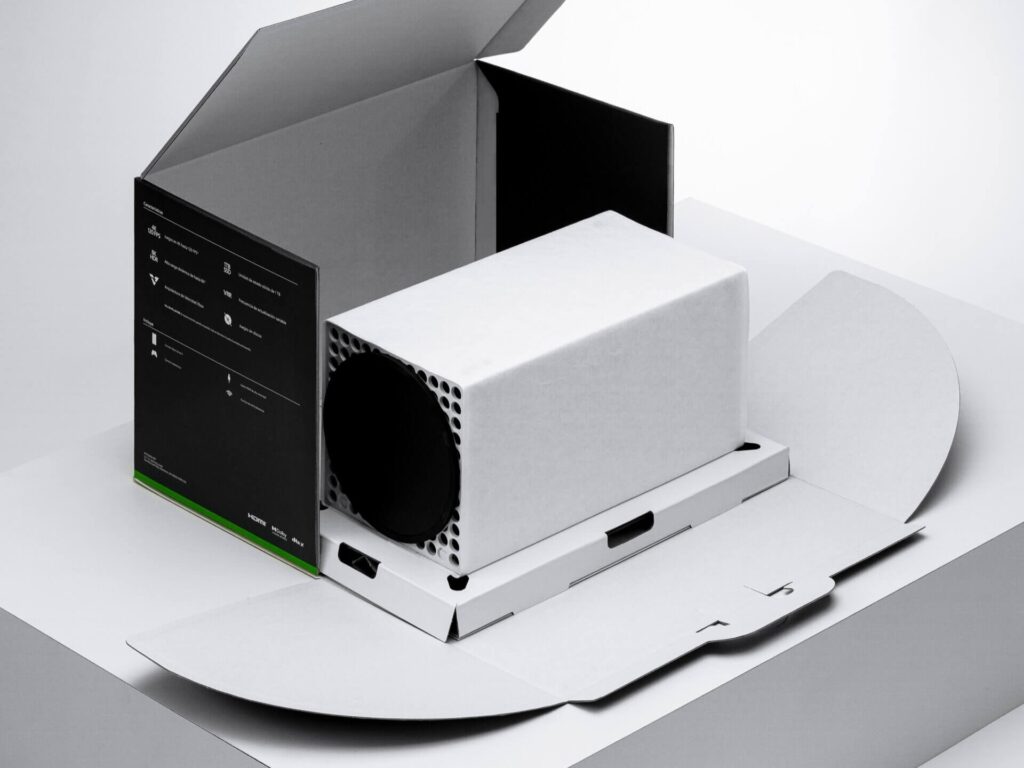
Their work emphasises how small design decisions can have a major impact. Features like pull tabs that require minimal force or structured unboxing sequences can determine whether a product feels empowering or frustrating. For users with limited dexterity, opening packaging independently can be the difference between reliance and autonomy.
For blind and low-vision users, Braille labelling and tactile markers transform packaging into something navigable rather than obstructive. Microsoft also highlights the importance of clear iconography and QR-based systems, enabling users to access guidance through assistive technologies.
What sets their approach apart is the philosophy behind it: accessibility is framed as an ongoing responsibility, not a one-time solution. Packaging becomes a touchpoint where empathy, usability, and technology intersect.
A Broader Shift in Design Thinking
Across these examples, a clear pattern emerges. Inclusive packaging is moving away from single-feature solutions toward integrated systems. Brands are no longer asking, “Can we add Braille?” but instead, “How does this entire experience work for someone with different abilities?”
This shift also reflects a growing understanding that disability is not a niche. Temporary injuries, ageing, and everyday situational limitations mean that accessible design benefits a far wider audience than often assumed.
While more brands are beginning to adopt this mindset, including McDonald’s, SnapSlide and PlayStation, there remains a significant gap in the market. Inclusive packaging should no longer be treated as an exception – it must become the expectation.
Sources