



 American Latina
 ANZ
 Austria
 Brazil
 Czech
 Finnish
 France
 Germany
 Italy
 North
America
 Norway
 Polish
 Portugal
 Spain
 Sweden
 United Kingdom
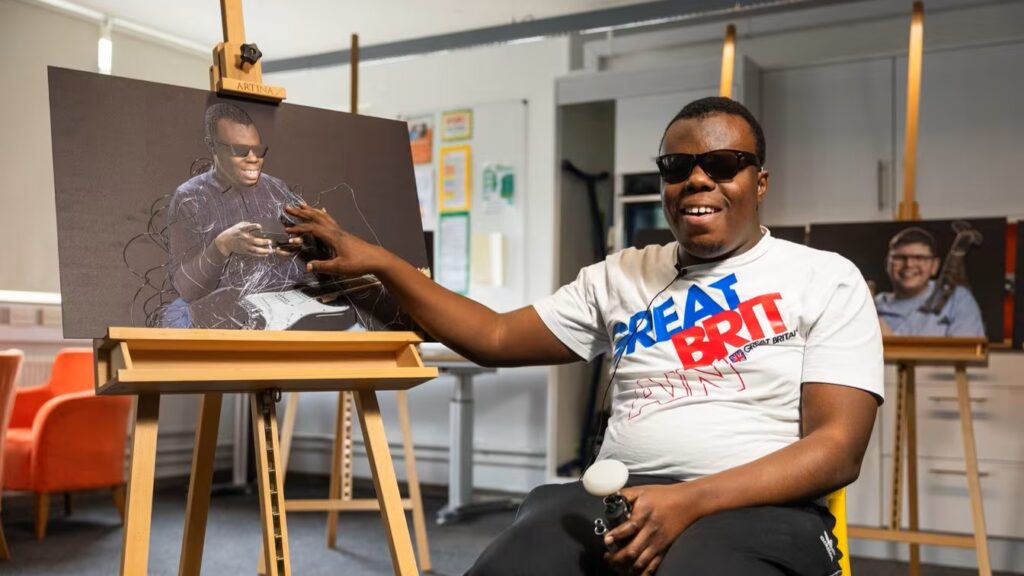
An innovative project between Canon and the Royal Society for Blind Children is demonstrating how print can bring images to life through touch, creating new ways for young people to experience creativity and visual storytelling.
Photography is traditionally an art form experienced through sight. But what if images could be felt as well as seen?
Canon has partnered with the Royal Society for Blind Children (RSBC) to create an accessible photography exhibition using tactile relief printing, allowing blind and partially sighted young people to explore images through touch, alongside descriptions and storytelling.
The project forms part of Canon’s Young People Programme, which supports young people from disadvantaged backgrounds and communities, and highlights how print can open up new opportunities for creative expression and inclusion.
Bringing images to life through touch
The project began late last year when Canon Ambassador, cinematographer and photojournalist Elisa Iannacone led a photography workshop for seven RSBC students at Dorton College in Orpington.
During the workshop, students created self-portraits inspired by their favourite activities, using photography to express their individual identities, interests and personalities.
The portraits have since been transformed into tactile relief prints using Canon’s elevated printing technology. Produced on a Canon Arizona 2380 XT with PRISMAelevate XL software, the prints use carefully designed height maps and multiple layers of UV-curable ink to create raised textures that can be explored by hand.
The power of print to connect
For Canon, the collaboration demonstrates how print can go beyond simply reproducing an image on a page or surface. By combining texture with photography, printed images become interactive experiences, encouraging exploration and creating a more personal connection with the artwork.
Neale Conroy, marketing director of Canon UK & Ireland’s Imaging Technologies & Communications Group, said the project had helped students experience photography in a completely new way.
He added that the collaboration demonstrated how elevated print technology could help young people connect with visual storytelling and share their perspectives.
Sarah Mallion, vice principal and head of business and operations at RSBC, said seeing students engage with their own work in such a tactile and meaningful way had been incredibly rewarding. She added that families had responded overwhelmingly positively and expressed hope that the initiative would lead to further accessible exhibitions and learning experiences.
Making creativity inclusive
The project builds on Canon’s wider exploration of multisensory print experiences, including its The World Unseen installation at drupa 2024, which featured elevated prints designed to make visual content accessible through touch.
Founded in 1838, RSBC supports blind and partially sighted children, young people and their families, providing inclusive education, activities and opportunities to build confidence and independence.
This collaboration shows how print can help remove barriers to participation, giving more young people the opportunity to engage with art, communicate their ideas and experience creativity in new ways.